On TRT or HRT

Your protocol, followed against your own history.

ILAI is built for people on a GLP-1, and the same discipline applies to testosterone and hormone replacement. The section below is what it does with a protocol.

Ask ILAI about a dose change

You changed your dose. Here is what it costs.

Tell ILAI what you did and why, in your own words. It answers from your record: what the change does to your next draw, the steady-state arithmetic, the other causes that fit what you are feeling, what to watch while the new dose settles, and what to take to your prescriber.

Alex asked:

“I increased my testosterone dose from 40g to 50m 3x a week because I notice declining libido at this dose that ive been on for a while now”

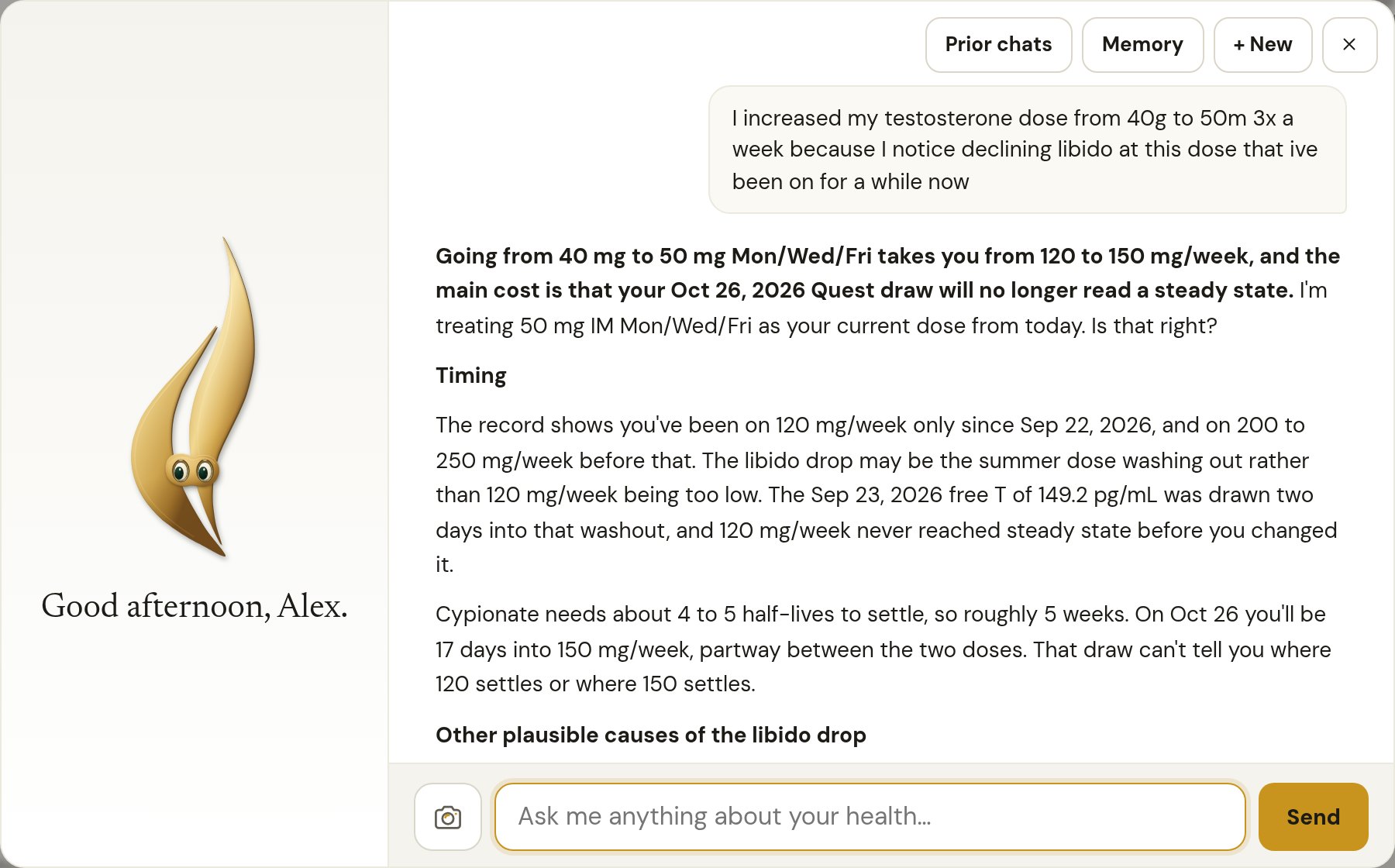
The Ask ILAI window on a laptop: ILAI on the left with “Good afternoon, Alex.”, and on the right Alex’s message about raising his testosterone from 40 to 50 three times a week, then the start of ILAI’s answer: going from 40 mg to 50 mg Mon/Wed/Fri takes him from 120 to 150 mg/week, and the main cost is that his Oct 26 Quest draw will no longer read a steady state; then the Timing section
The conversation in ILAI, as Alex saw it.

ILAI answered:

Going from 40 mg to 50 mg Mon/Wed/Fri takes you from 120 to 150 mg/week, and the main cost is that your Oct 26, 2026 Quest draw will no longer read a steady state. I’m treating 50 mg IM Mon/Wed/Fri as your current dose from today. Is that right?

Timing

The record shows you’ve been on 120 mg/week only since Sep 22, 2026, and on 200 to 250 mg/week before that. The libido drop may be the summer dose washing out rather than 120 mg/week being too low. The Sep 23, 2026 free T of 149.2 pg/mL was drawn two days into that washout, and 120 mg/week never reached steady state before you changed it.

Cypionate needs about 4 to 5 half-lives to settle, so roughly 5 weeks. On Oct 26 you’ll be 17 days into 150 mg/week, partway between the two doses. That draw can’t tell you where 120 settles or where 150 settles.

Other plausible causes of the libido drop

  • Lexapro 10 mg: SSRIs reliably blunt libido. This has been a constant, but it lowers your baseline.
  • Sleep: you logged "can’t fall asleep" 8 times in 30 days, most recently at 8/10 on Oct 6, 2026. Your HRV this morning was 22 ms against a 7-day average of 37.3. Poor sleep and stress suppress libido independently of T.
  • Tirzepatide restart on Oct 1, 2026 and the GI episode: both cut appetite and drive generally.
  • E2: anastrozole stopped Sep 21, 2026. The Rythm E2 of 23.6 pg/mL isn’t MS-based. HCG at 750 IU/week plus more testosterone will push E2 up, and low E2 also hurts libido.

What I’d watch at 150 mg/week

  • Hematocrit: 50.44% on Sep 23, 2026, with ferritin now 124 ng/mL, so iron no longer limits red-cell production. The Oct 12, 2026 CBC matters more now.
  • Total T: using your calibration of 5 to 5.5 ng/dL per mg/week, the estimated range is 750 to 825 ng/dL. That calibration came from draws on HCG at 1,500 IU/week, so treat it as rough. It’s still well under your 1,200 to 1,400 ceiling.
  • Overnight oxygen: blood oxygen dipped below 88% on 5 of 22 nights. More androgen and a higher hematocrit make a sleep evaluation more worthwhile.

For your prescriber to consider

Send this through Message practice on Today: the dose change and the reason, the Oct 12 CBC, and whether to move the Quest draw to around Nov 13, 2026. A draw then would be about 5 weeks on 150 mg/week, so free T by dialysis and LC/MS/MS E2 would show where this dose actually lands. If you keep Oct 26, read it as a mid-transition snapshot and don’t titrate from it. The ezetimibe and ApoB decision can still use Oct 26, since ApoB isn’t waiting on testosterone steady state.

Track libido in your symptom log every few days. If it recovers within 1 to 2 weeks, before levels could have risen much, that points to sleep and stress rather than dose.
Also on TRT or HRT

“In range” is not the same as fine.

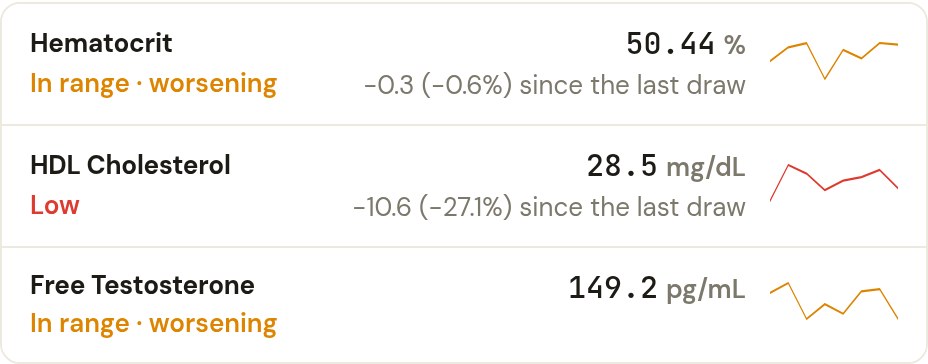
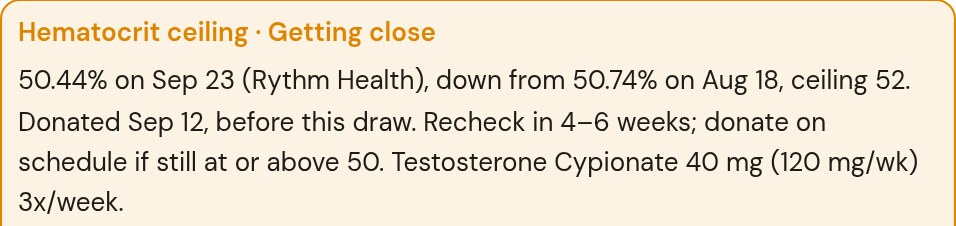
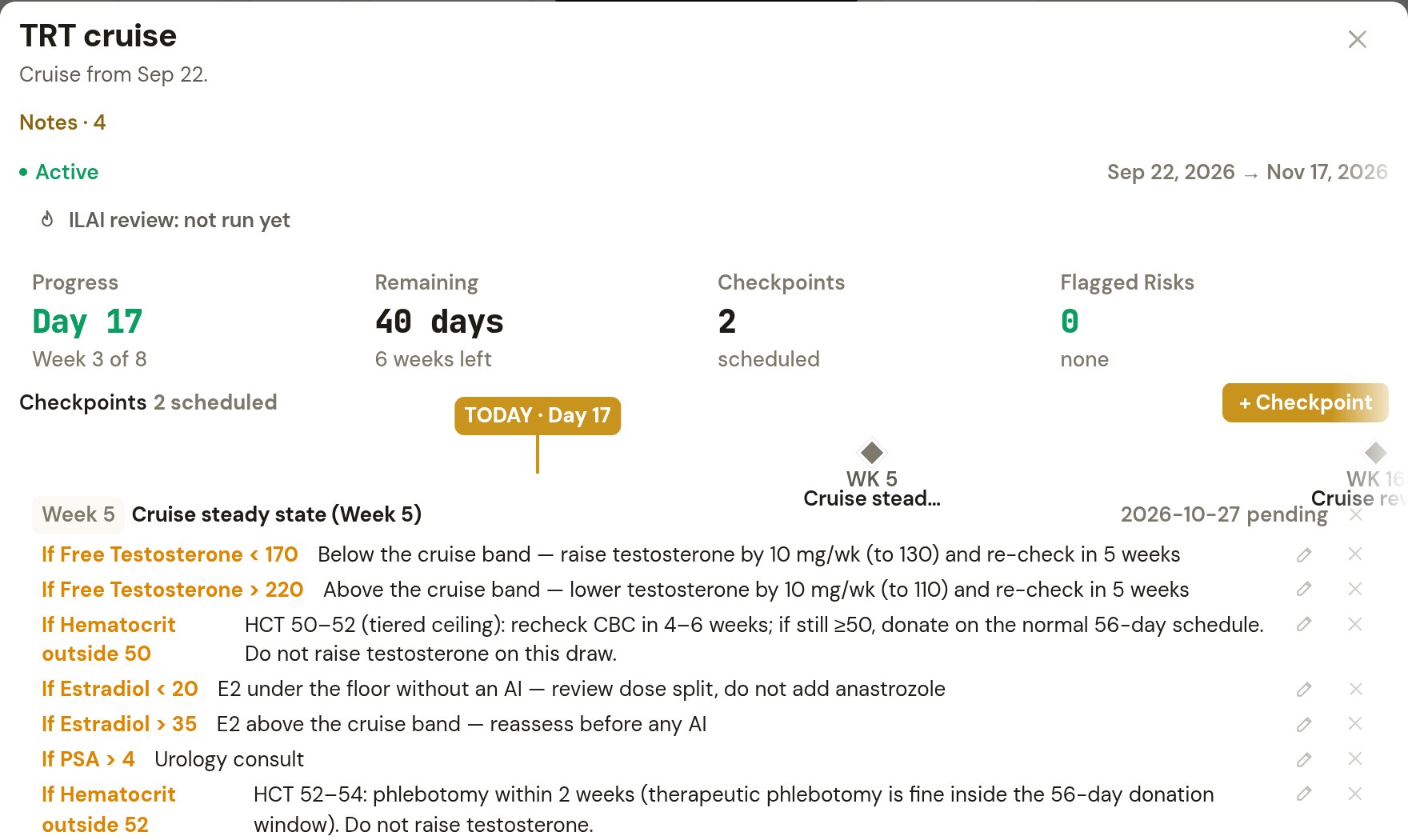
Enter your protocol once: each medication, its dose and its schedule. ILAI suggests the lab checks that decide what comes next, raise, hold or lower, and when results arrive it shows which check they meet. Over weeks and months it follows every result against your own history, not only the lab’s range. Alex’s hematocrit came back in range; ILAI noted it was close to his ceiling and drawn eleven days after a blood donation, which lowers the value, so the settled number was likely higher.

“Your record shows you’re already on 0.5 mg of semaglutide, and the next increase should wait for a lipase result.”ILAI, to Michael, when he asked about going up
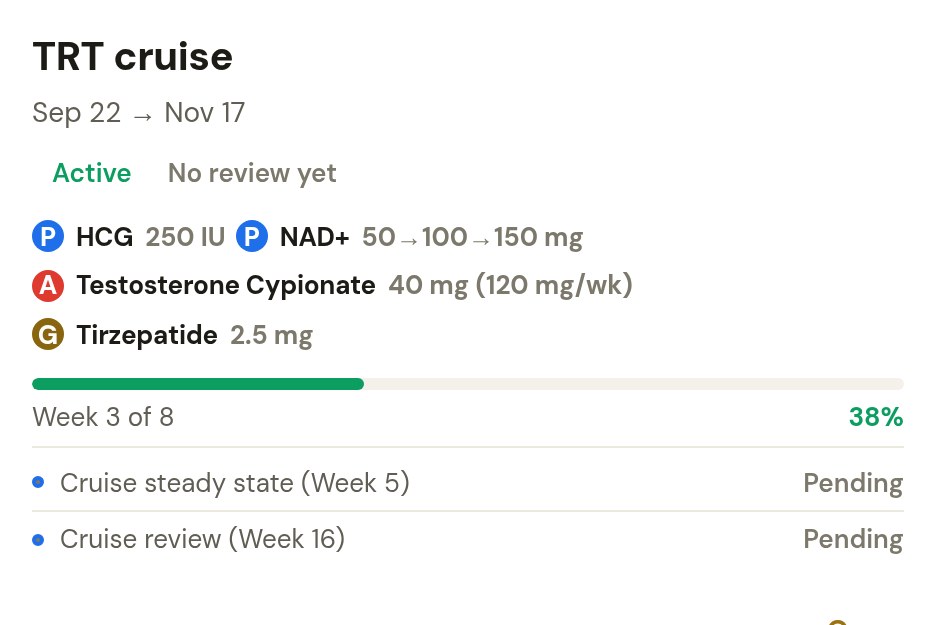
Alex’s TRT cruise, day 17 of 8 weeks, with the week-5 checkpoint rules: if free testosterone is under 170, raise by 10 mg a week and re-check in 5 weeks; over 220, lower by 10 mg; hematocrit, estradiol and PSA limits with the step each one triggersThe same protocol on the phone: testosterone cypionate 40 mg, HCG, NAD+ and tirzepatide 2.5 mg; week 3 of 8 with two reviews pending
Alex’s TRT plan: the lab checks that decide his next step, and the plan on his phone.
Three spotlight rows after the Sep 23 draw: hematocrit 50.44% in range and worsening, HDL 28.5 low, down 27% from the prior draw, free testosterone 149.2 in range and worseningThe hematocrit note: 50.44% on Sep 23, down from 50.74% on Aug 18, ceiling 52; donated Sep 12, before this draw; recheck in 4 to 6 weeks and donate on schedule if still at or above 50
Alex’s September 23 draw, with ILAI’s note on the hematocrit.

The same discipline applies to a GLP-1. Michael’s plan carries a lipase check at the titration review; when his September draw came back without one, ILAI said the increase should wait and named the test.